Invest in the International Real Estate Market: Opportunities, Strategies, and Smart Plays for 2026
In an era of economic uncertainty and shifting global capital flows, invest in the international real estate market has re-emerged as one of the most resilient and rewarding asset classes. As we move through Q2 2026, global real estate investment volumes are projected to climb 15% year-on-year, pushing total turnover past $1 trillion for the first time since 2022. Stabilizing valuations, returning liquidity, and structural tailwinds—AI-driven data centers, living sectors, and private wealth deployment—are creating a compelling entry point for diversified investors.
Whether you’re a high-net-worth individual, family office, or institutional player, investing beyond your home market offers portfolio diversification, inflation hedging, higher yields in select jurisdictions, and lifestyle or residency benefits. This professional guide explores the 2026 landscape, spotlights high-potential markets like Dubai and India, and outlines actionable strategies to succeed.
Global Real Estate Outlook 2026: Recovery Meets Transformation
The 2026 investment climate is markedly more optimistic than the previous two years. According to the Emerging Trends in Real Estate Global 2026 report from PwC and the Urban Land Institute, improving fundamentals—manageable inflation, accretive leverage, and constrained supply—are driving renewed appetite across the US, Europe, and Asia-Pacific.
Key themes shaping the year:
- Operational real estate and data centers lead the charge, fueled by AI demand.
- Living sectors (residential, multifamily, student housing) are forecast to exceed $250 billion in global investment.
- Private wealth and cross-border capital are rising, with Middle Eastern, Asian, and European family offices actively reallocating.
- Geopolitical caution meets selectivity—investors favor stable, transparent markets with strong governance and residency pathways.
Cross-border activity is up 25% from 2024 levels, with India, Germany, the UK, and Singapore emerging as top non-domestic targets for many global respondents. Yet one market continues to punch above its weight for yield-hungry investors: Dubai.
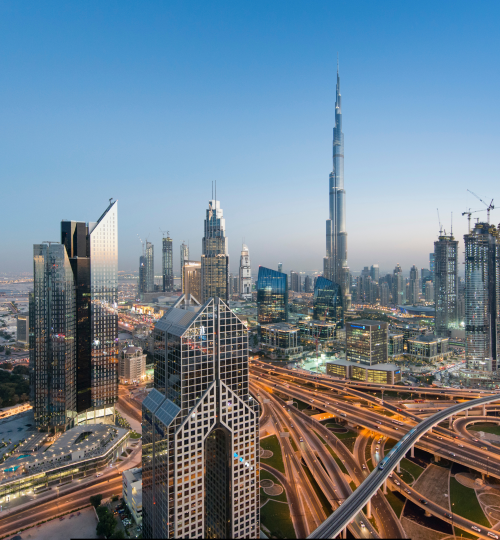
Why Dubai Remains a Premier International Real Estate Destination
Dubai’s property market closed 2025 on a record note—over 215,700 transactions with a 30.9% surge in value—and 2026 is shaping up as a year of sustainable, high-quality growth rather than explosive speculation.
Core Investment Advantages in 2026:
- Rental Yields (6–10%): Among the highest globally, far outpacing most Western markets.
- Tax-Free Environment: Zero property tax, zero capital gains tax on resale, and no income tax on rental returns.
- Golden Visa Pathway: Property investments starting at AED 2 million (approx. $545,000) unlock long-term residency for investors and families.
- Strong Fundamentals: Population growth, economic diversification, and infrastructure megaprojects (Etihad Rail, Dubai Metro expansions) support steady demand.
- Liquidity and Transparency: A mature, English-language market with fast transaction timelines and strong developer delivery.
Analysts describe 2026 as a “normalization phase”—moderate price growth of 6–10% in residential segments, with villas continuing to outperform apartments and mid-market housing seeing robust activity. This stabilization is healthy: it rewards long-term, data-driven investors rather than short-term speculators.
For international buyers—especially from India, the UK, and Europe—Dubai functions as both a high-yield cash-flow engine and a safe-haven asset. Even amid regional geopolitical headlines, the emirate’s fundamentals (equity-heavy ownership, diversified economy, and investor-friendly policies) keep it structurally stronger than many peers.
India vs. Dubai: Complementary Markets in a Dual-Allocation Strategy
Savvy global investors are increasingly adopting a “Dubai + India” playbook. The two markets offer distinct but perfectly complementary risk-return profiles.
| Factor | Dubai | India (Select Cities) |
|---|---|---|
| Rental Yield | 6–10% (tax-free) | 2–3% |
| Capital Appreciation | Moderate & steady (6–10%) | Higher potential (8–15% in growth corridors) |
| Taxation | Zero on property/rentals | Capital gains + GST implications |
| Entry Barriers | Straightforward, fast | More complex approvals |
| Residency Benefits | Golden Visa | None (OCI card for NRIs) |
| Primary Driver | Expat demand, tourism, global capital | Domestic consumption, IT/infra boom |
Dubai excels at delivering immediate, tax-efficient income and lifestyle/residency perks.
India offers superior long-term wealth creation through urbanization, policy reforms, and demographic tailwinds—particularly in cities like Pune, Gurugram, Hyderabad, and Bengaluru.
Institutional players now treat the pair as a single corridor: Dubai anchors the portfolio with stable yields, while India captures growth upside. Indian NRIs, in particular, poured ₹85,000–95,000 crore into Dubai residential real estate in 2025 alone, making them the largest foreign buyer group.
Other High-Conviction International Markets for 2026
While Dubai and India dominate many allocation discussions, diversification remains key. Top alternatives include:
- Portugal & Spain: Golden Visa-style programs (though evolving), strong tourism-driven yields, and EU stability.
- Turkey: Competitive yields, rapid appreciation potential, and citizenship pathways.
- Greece: Affordable entry, high rental demand in islands and Athens.
- Thailand & Indonesia (Bali): Tourism recovery and lifestyle appeal for Asian-focused investors.
- US Secondary Cities (e.g., Nashville): Domestic growth plays with strong fundamentals.
Each market suits different objectives—yield vs. growth, residency vs. pure return.
Practical Steps to Invest in International Real Estate in 2026
- Define Your Objectives: Yield generation? Capital appreciation? Residency? Tax efficiency?
- Conduct Rigorous Due Diligence: Work with regulated local advisors, review developer track records, and stress-test rental assumptions.
- Understand Currency & Tax Implications: Factor in exchange-rate volatility and home-country tax treaties.
- Leverage Professional Structures: Use SPVs, REITs, or funds where appropriate for liquidity and governance.
- Start with a Pilot Allocation: Many successful investors begin with 10–20% of their portfolio in one offshore market before scaling.
- Monitor Geopolitical & Macro Risks: Diversification across 2–3 jurisdictions mitigates single-market exposure.
Risks to Consider
No investment is risk-free. Currency fluctuations, regulatory changes, supply gluts, or prolonged geopolitical tensions can impact returns. In Dubai, 2026’s normalization means buyers must be selective—prime locations and quality assets will outperform. In India, execution risk around project delivery remains a factor.
The antidote? Partner with experienced, transparent teams and focus on fundamentals over hype.
Why should I consider international real estate investment in 2026?
Is Dubai still one of the best international real estate markets in 2026?
How does investing in Dubai compare with India?
What is the minimum investment required for the Dubai Golden Visa?
Conclusion: The Case for International Real Estate in 2026
Investing in the international real estate market today is less about chasing last year’s boom and more about positioning for the next decade of structural growth. Dubai offers unmatched yield, stability, and lifestyle upside. India delivers scale and long-term appreciation. Together, they form a powerful dual strategy that many global investors are now embracing.
The window is open—but it favors disciplined, informed capital. Whether you’re an NRI reallocating from domestic markets, a European family office seeking diversification, or an institutional allocator targeting 8–12% risk-adjusted returns, international real estate in 2026 deserves serious consideration.
Next Step: If you’re exploring opportunities in Dubai, India, or a blended portfolio, the right local expertise can make all the difference. Reach out to trusted advisors who understand cross-border dynamics and can tailor solutions to your specific goals.
The global real estate map is evolving. The question is no longer whether to invest internationally, but where and how to do it smartest. 2026 may well be remembered as the year forward-thinking investors secured their positions for the decade ahead.
This article is for informational purposes only and does not constitute financial or investment advice. Always consult qualified professionals before making investment decisions.